

Were Can You Download Gacha Life 2
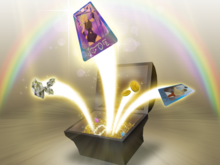
Gacha mechanics take been compared to those of boodle boxes
A gacha game (Japanese: ガチャ ゲーム, Hepburn: gacha gēmu ) is a video game that implements the gacha (toy vending machine) mechanic. Similar to loot boxes, gacha games entice players to spend in-game currency to receive a random in-game particular. Some in-game currency mostly can be gained through game play, and some by purchasing it from the game publisher using existent-world funds.
Most implementors of the Gacha model are free-to-play (F2P) mobile games.[ane] [ii]
The gacha game model began to be widely used in the early 2010s, particularly in Nihon.[1] [two] Most of the highest-grossing mobile games in Nippon utilise it, and it has become an integral part of Japanese mobile game culture.[iii] The game mechanism is as well increasingly used in Chinese and Korean games, besides as Western games.[3] [4] [5] [vi] Despite their ubiquity, gacha games take been criticized for being addictive, and are often compared to gambling due to the incentive to spend real-world money on chance-based rewards.
Model [edit]
Rolling/Pulling [edit]
In that location are many collectable characters, cards, or other items (details will vary based on nature of game). Many of them are obtainable only through a "gacha" mechanic.[3] In this, the histrion "pulls" or "spins" in a manner analogous to a slot automobile or roulette cycle. In doing and then they expend some of a premium currency in commutation for receiving a random "drop" from the banner "rolled on". Some of the rewards drop less frequently than others. It is common for the schema of particular rarities to be public data, dubbed "open gacha". It is common for at that place to be a rarity tier on around the society of actualization in one percentage of rolls. Between this rarity and the commonality of express-time availability of promoted gacha drops, players are encouraged to roll the gacha while their desired particular is available.[three]
Pity [edit]
Some gacha models apply a pity system: the player will be guaranteed an detail after pulling for that particular a large number of times without success. "Soft" pity increases the probability slightly of getting a rare detail with every pull, counting up and recalculating the probability until the rare item is received, while "hard" pity uses a counter to go on runway of the number of pulls and automatically dispense the rare item afterwards reaching a preset number of rolls.
In-Game Currency [edit]
Games can include multiple in-game currencies with circuitous schemes for converting between them. This makes it more difficult for the role player to model the dollar cost of a unit of a currency that isn't the "premium" one.
It is mutual for it to be possible to get even the "premium" (obtained with real money) currency through gameplay, albeit in rigorously express quantities.
Virtual Item [edit]
Many kinds of virtual items tin be in the loot table for a imprint. Gameplay units such as cards, characters, equippable gear, or more abstract loot such equally "experience" are all possible.
Login & Job Rewards [edit]
In many games, gacha rewards are essential for players to brand progress in the game.[6] Players are generally given gratuitous or discounted gachas in low amounts on a regular schedule, in exchange for logging in or doing in-game tasks.
Common mechanics [edit]
[edit]
Banners are "pools" of available items (characters, boodle, cards, etc) that players can "roll" on. Offered banners can be perpetually available or can have a express duration. Games by and large take some of both, with thespian retention efforts and in-game advertising emphasizing the limited availability of some or all of the items in the latter.
[edit]
Sometimes, these banners are limited, such that specific prizes tin can just exist obtained within a specific event time-frame.[3]
Stamina [edit]
Stamina is a resource that is required for, and consumed by, core in-game actions such as (in a fighting-oriented game) beginning combat encounters. It regenerates over time, often up to a cap. It can typically exist regenerated or gained instantly through some form of microtransaction or premium currency spending.
Variations [edit]
| Mechanic | Description |
|---|---|
| Complete gacha | "Consummate gacha" ( コンプリートガチャ ), also shortened as "kompu gacha"[seven] [viii] or "compu gacha"[nine] ( コンプガチャ ), was a monetization model popular in Japanese mobile telephone video games until 2012, when it was institute to be illegal past Japan'southward Consumer Affairs Agency. Players gyre in attempt to "complete" a set of mutual items from item boodle pool in order to unlock a rare item. The start few items in a set tin exist rapidly caused simply as the number of missing items decreases it becomes increasingly unlikely that redeeming a loot box will complete the set (see coupon collector's problem). This is particularly true if there are a big number of common items in the game, since eventually one single, specific item is required.[viii] |
| Box gacha | There is a gear up of items in specific quantities; this is the "box". The thespian rolls for items in the box; rolled items are deducted from the item amounts remaining in the box. As a result, over successive rolls, the set of possible "draws" shrinks until the histrion has all of the items.[ten] [11] Its popularity grew effectually the time that the complete gacha controversy was becoming publicized. |
| Redraw gacha | Redraw gacha allows the player to "re-roll" the gacha , returning their fatigued item in substitution for some other opportunity to draw, so as to potentially get something else. Some games offering this characteristic for free.[ten] In games that offer some free gacha rolls at the first, beginning players may "re-curlicue" past creating new accounts and doing the starter rolls on each until they get the draws they desire.[12] |
| Consecutive gacha | Consecutive gacha improves the chances of receiving rare rewards when the player spends in bulk. As opposed to spending a set up amount for private rolls, a role player can spend a larger amount in society to roll several times in a row for a slightly discounted price.[11] |
| Pace-up gacha | The player'due south rates are improved for each consecutive roll or case of spending within a unmarried session or a express fourth dimension period (e.chiliad. five checkpoints; must roll v times or spend five times inside half an 60 minutes to get the rewards for step 1, two, three, four, and v in succession.)[11] |
| Open versus closed gacha | Gacha that show (open) versus hide (closed) the exact probabilities of pulling rare items.[10] |
| Sugoroku gacha | Sugoroku (literally "double vi") "game board" gacha involve moving around on a virtual game board to obtain rewards. Generally move is performed by rolling die and the die rolls can be directly or indirectly accrued through rolling. |
Appeal [edit]
Game developers take praised gacha as a free-to-play monetization strategy.[13] [6] Virtually developers that piece of work primarily with free-to-play games recommend it exist incorporated into the game starting with the concept for maximum monetization potential.[half-dozen]
It has been debated what makes gacha so addictive to so many players. Proposed mechanisms include playing on the hunter-gatherer instinct to collect items, too as the desire to consummate a ready,[6] effective use of the "fear of missing out", or, simply the aforementioned mechanisms that drive gambling.[13]
The model of gacha has been compared to that of collectible trading card games as well as to gambling.[13]
Whales [edit]
An attribute of monetisation normally establish in the financing of gacha games involves a model where a large part of the game'southward revenue comes from a very pocket-size proportion of players who spend an unusually large amount of coin on gacha rolls, essentially subsidising the game for other players who may spend smaller amounts of money, or fifty-fifty free-to-play players that spend no money at all. The high-spending players are often colloquially referred to as "whales".[12]
Criticism and controversy [edit]
Resemblance to gambling [edit]
In May 2012, an article was published in a bourgeois Japanese newspaper, the Yomiuri Shimbun, that criticized social networking games and specifically gacha for exploiting the naivety of children to make a profit. The main complaint of the article was that the gacha model too closely resembled gambling. The paper chosen for an investigation by Nihon's Consumer Diplomacy Agency to foreclose abuse of the arrangement.[fourteen] Several cases of teenagers and even younger kids spending equivalents of over 1000 USD have been reported in the media.[15] [16] Shortly after, the suggested investigation was performed and the model of complete gacha was declared illegal by the Consumer Affairs Agency, citing the Law for Preventing Unjustifiable Extras or Unexpected Benefit and Misleading Representation ( 不当景品類及び不当表示防止法 ),[9] [8] The Consumer Affairs Bureau stated that virtual items could be considered "prizes" under existing legislation written in 1977 to prevent the complete gacha practice in the context of baseball trading cards. Within a month of the argument being issued, all major Japanese game publishers had removed complete gacha rules from their games, though many developers found ways around this.[8] [17] In addition, several lawsuits were launched in Nihon against companies selling gacha products, leading to temporary subtract in their stock marketplace value by nigh a quarter.[18] [19] [20] Japanese mobile game developers, including GREE and DeNA, worked to institute a self-regulating industry grouping, the Nippon Social Game Association, which was an endeavour to push button developers from these models, but it did not prove successful, and the Association was disbanded past 2015.[17]
The mechanism has come up under scrutiny for its similarity to gambling, and some countries crave drib rates to be made public, or take banned certain practices (e.g., complete gacha ).[21] [22] Many players also feel regret after making purchases in these games according to a survey.[23] This type of game has also come under criticism for luring players into spending thousands of dollars at a time to get what they want,[24] and the way gacha outcomes are presented inside the game have also been criticized.[25] Children are likely to be affected past the gambling-similar mechanism since mobile devices provides like shooting fish in a barrel admission to payment; some game developers besides intentionally introduce emotional manipulations and exploitive practices.[26] A 2019 research newspaper has noted that "the gacha system has proven to be addictive and problematic" and speculated that the loopholes in the gacha system could be exploited for international coin laundering.[18]
See as well [edit]
- List of gacha games
- Loot box
- Microtransaction
References [edit]
- ^ a b Toto, Serkan. "Gacha: Explaining Japan's Elevation Money-Making Social Game Machinery". Serkan Toto: CEO Blog. Kantan Games. Retrieved ten April 2020.
{{cite spider web}}: CS1 maint: url-status (link) - ^ a b "'Fire Keepsake Heroes' Is a Gacha Game - Here'south What That Ways". Inverse . Retrieved 10 April 2020.
{{cite news}}: CS1 maint: url-condition (link) - ^ a b c d e "Japanese gachas are sweeping F2P games in the West". 2 November 2016.
- ^ "Nintendo'due south Mobile 'Burn Emblem' Is a 'Gacha' Game, Here's What That Means". Waypoint. xix January 2017. Retrieved 23 May 2017.
- ^ Nakamura, Yuji (iii Feb 2017). "Nintendo treading on shaky ground equally new mobile game takes 'gacha' global". Japan Times Online.
- ^ a b c d e Heinze, Johannes (18 July 2017). "How gacha can benefit Western game developers". GamesIndustry.biz . Retrieved 12 Nov 2019.
{{cite web}}: CS1 maint: url-condition (link) - ^ "Kompu gacha freemium systems banned in Nippon". VG247. 18 May 2012. Retrieved 17 May 2015.
- ^ a b c d Akimoto, Akky (16 May 2012). "Japan's social-gaming industry hindered past government's anti-gambling move". The Japan Times. ISSN 0447-5763. Retrieved xiii August 2017.
- ^ a b "Social Games' "Compu Gacha" Model Officially Alleged Illegal". Siliconera. eighteen May 2012. Retrieved xv July 2021.
- ^ a b c Koeder, Marco; Tanaka, Ema; Sugai, Philip (June 2017). "Mobile Game Price Discrimination outcome on users of Freemium services– An initial outline of Game of Adventure elements in Japanese F2P mobile games" (PDF). 14th International Telecommunications Social club (ITS) Asia-Pacific Regional Conference: "Mapping ICT into Transformation for the Adjacent Information Social club".
{{cite web}}: CS1 maint: url-status (link) - ^ a b c Toto, Dr Serkan (fourteen March 2016). "How Japanese Mobile Game Makers Go Later on Whales: 5 Popular Gacha Mechanics – Kantan Games Inc. CEO Weblog". Retrieved 12 Nov 2019.
{{cite web}}: CS1 maint: url-status (link) - ^ a b Flachner Balázs (22 July 2020). "Virtuális kemény drog tolja a mobilos játékok szekerét". Index.hu (in Hungarian). Archived from the original on 22 July 2020. Retrieved 22 July 2020.
- ^ a b c Will Luton (2013). Gratis-to-Play: Making Money From Games You Give Away. New Riders. p. 88. ISBN978-0-13-341124-9.
- ^ "Social networking games must be responsible." Yomiuri Shimbun. May 29th, 2012. [1]
- ^ Russell, Jon (half-dozen May 2012). "Japan Mulls Ban on Controversial simply Lucrative Game Genre". The Next Spider web . Retrieved ii September 2020.
- ^ "Heroines Are A Dangerous Drug: Japanese Users Spend Massive Money On Imaginary Idols". Kotaku . Retrieved 2 September 2020.
- ^ a b Hood, Vic (20 October 2017). "What the United kingdom of great britain and northern ireland can learn from the Far Due east's battle with loot boxes". Eurogamer . Retrieved 23 October 2017.
- ^ a b Pramanta, Rio Akbar; Utomo, Tri Cahyo (26 September 2019). "Psychoanalytical Arroyo to Transnational Money Laundering Utilizing Japanese Mobile Online Games with Gacha Arrangement: A Forecasting Written report". Periodical of International Relations. five (4): 646–652.
- ^ "$6,065 Spent in One Night Shows Dark Side of Japan'south Mobile Games". Bloomberg.com. 9 March 2016. Retrieved ii September 2020.
- ^ Barder, Ollie. "Japanese Mobile Gaming Still Tin't Milkshake Off The Spectre Of Exploitation". Forbes . Retrieved two September 2020.
- ^ Feit, Daniel. "Gacha Watch: Japan's Social Game Industry Shifts Gears Later Regime Crackdown". WIRED . Retrieved 23 May 2017.
- ^ "Prc's new police force forces Dota, League of Legends, and other games to reveal odds of scoring skillful boodle". ii May 2017.
- ^ "Gacha Picket: 60% of Japan's Social Game Players Have Buyer's Remorse". Wired. 27 August 2012.
- ^ Barder, Ollie. "Japanese Mobile Gaming Still Can't Milk shake Off The Spectre Of Exploitation". Forbes.
- ^ "バンダイナムコ、スマホ「ガチャ」で誤表示". 15 November 2017.
- ^ Liu, Kevin (1 July 2019). "A Global Analysis into Loot Boxes: Is It "Most" Gambling?". Washington International Police force Journal. 28 (3): 763. ISSN 2377-0872.

Were Can You Download Gacha Life 2,
Source: https://en.wikipedia.org/wiki/Gacha_game
Posted by: crawfordstaideadrost.blogspot.com
0 Response to "Were Can You Download Gacha Life 2"
Post a Comment